
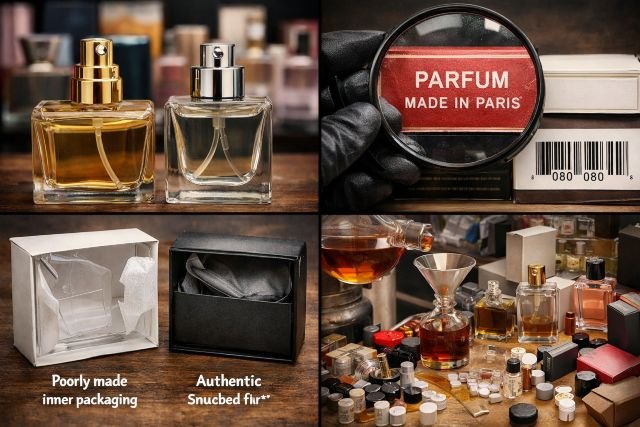
If you’ve ever hesitated before buying a discounted designer scent online, your instincts are doing you a favor. Fake perfume has become more convincing, more widely distributed, and easier to sell through social platforms, resale groups, and third-party marketplace listings. The real problem is that fragrance is a “trust product.” Most buyers can’t lab-test a bottle, and counterfeiters know it. They aim to fool you in the first ten seconds: the box looks right, the bottle looks right, and the opening spray smells close enough to silence doubt.
This article gives you a practical, real-world way to protect yourself. You’ll learn the most common counterfeit seller tricks, the small details that separate authentic from fake, and a step-by-step verification approach that works whether you’re buying in person or online. You’ll also see why the risk isn’t only about wasting money. Counterfeit trade is large enough to be tracked by major institutions, and it’s repeatedly linked to consumer safety concerns.
What counts as fake perfume?
A fake perfume is a product sold as an authentic branded fragrance when it isn’t. Sometimes it’s a direct counterfeit that copies the brand name, bottle design, and packaging. Sometimes it’s a “refill scam,” where a genuine-looking bottle is filled with cheaper liquid and resold as new. Other times it’s a near-identical clone using lookalike printing, mismatched batch codes, and a scent designed to imitate only the earliest notes.
The key difference is intent and representation. If a product is marketed clearly as a different brand “inspired by” a scent profile, that’s a dupe category. It might be good or bad, but it isn’t pretending to be the original brand. A counterfeit product is doing exactly that: borrowing identity, reputation, and consumer trust.
Why fake perfume is booming now
Counterfeiting isn’t a niche issue. The OECD–EUIPO has estimated global trade in counterfeit goods at USD 467 billion (2021), highlighting consumer safety and supply chain risks. When you zoom in on enforcement signals, the scale looks even more tangible. EUIPO reporting on a joint EUIPO–European Commission publication noted that EU authorities detained 152 million counterfeit articles in 2023, with an estimated value of €3.4 billion.
Perfume is especially attractive to counterfeit sellers for three reasons.
First, verification is hard. A bag has stitching patterns and hardware markings; a fragrance is a liquid inside a pretty bottle. Counterfeiters can mimic what buyers notice most: the box front, the cap shape, the label design, and the first spray.
Second, online selling reduces consequences. Bad actors can cycle store names, delete listings, and shift platforms. The “distance” between seller and buyer also makes it easier to blame shipping, storage, or “batch variation” when a product smells off.
Third, fragrance margins and brand desirability create perfect bait. A popular scent at a steep discount triggers urgency and the fear of missing out. Counterfeiters don’t need every buyer to be fooled; they just need enough buyers to accept the product or miss the return window.
The risks of fake perfume aren’t only “it doesn’t last”
A disappointing scent profile is the mildest outcome. The bigger concern is that counterfeit products operate outside the quality controls used in legitimate supply chains. Major regulators consistently warn that counterfeit products can contain incorrect, unknown, or harmful ingredients because they aren’t produced under the same standards or oversight. The U.S. FDA, for example, warns that counterfeit products may contain the wrong ingredients or other harmful ingredients, emphasizing the health risks when products are passed off as authentic.
With fragrance specifically, there’s another layer: real brands and manufacturers often align with established safety frameworks for fragrance ingredients, such as IFRA Standards, which outline restrictions, bans, and criteria based on scientific review and risk management. Counterfeiters don’t follow these frameworks. Even if you personally never react to fragrance, you’re still accepting an unknown exposure profile when you use a counterfeit bottle repeatedly on skin, clothes, and in enclosed spaces.
The tricks counterfeit sellers don’t want you to recognize
Counterfeit sellers rarely say “fake.” Instead, they use phrases designed to sound legitimate while giving themselves an escape route if you complain.
One common move is the “no box” story. Genuine bottles sometimes circulate without boxes, but a seller repeatedly offering popular scents “without box” at extreme discounts is often using that claim to explain away packaging flaws.
Another frequent claim is “tester bottle, same juice.” Real testers exist, but counterfeiters love the word “tester” because it implies industry access and “authorized backdoor supply.” When a seller has unlimited testers across multiple high-demand releases, that consistency can be a red flag, not reassurance.
You’ll also see “customs clearance,” “factory overstock,” or “warehouse sale” narratives. These stories are crafted to normalize an unrealistic price. The enforcement data from EU authorities shows how large counterfeit flows can be, which is exactly why these narratives feel plausible to buyers. The story is designed to make you feel like you’re benefiting from the system, rather than being targeted by it.
Finally, watch for language that subtly lowers your expectations. Phrases like “same as original,” “identical smell,” or “1:1 quality” are often used to condition you to accept differences. If it truly were the original product, the seller wouldn’t need a “trust me” vocabulary.
How to spot fake perfume in the real world
The best way to avoid being fooled is to stop relying on a single indicator. Authenticity is usually a pattern: many small signals align. Counterfeits often pass a few tests and fail the rest.
Seller signals that matter before you buy
Start by assessing the seller’s accountability. Legit sellers are comfortable sharing clear photos of the actual item, including the bottle base, the sprayer, and any batch code markings. They also have an authenticity-friendly return policy, meaning they don’t treat “not authentic” complaints as a personal insult or an impossible claim.
If the listing uses only stock photos, avoids showing the bottom of the bottle, or gets defensive when asked for proof of purchase, treat that as information. Counterfeit sellers rely on urgency, not transparency.
Packaging tells: where counterfeiters cut corners
Counterfeits often look “right” from the front and “off” from the sides. Pay attention to how clean the printing looks under zoom, whether the fonts match official product photos, and whether the packaging geometry feels precise. Many counterfeit boxes feel slightly softer or poorly cut compared with retail packaging, especially around edges, flaps, and inner supports.
Cellophane wrapping can also tell a story. Authentic retail wrapping is usually tight and consistent; many counterfeits have loose wrap, uneven seams, or sloppy folds. This isn’t universal, but it’s a useful supporting signal when combined with others.
Batch codes and mismatch patterns
Batch codes can help, but they shouldn’t be treated as a magic stamp. The practical rule is consistency. If the box shows a batch code and the bottle shows a batch code, the formatting should look aligned with the brand’s typical approach, and the codes should generally match in ways that make sense for the product.
Counterfeiters sometimes reuse the same batch code across many units, especially when they’re printing packaging in bulk. If you’ve noticed multiple listings from the same seller showing the same batch code, that’s worth taking seriously.
Bottle construction and sprayer performance
Authentic fragrance packaging tends to have tight tolerances. Caps seat properly, sprayers produce a fine, even mist, and labels are aligned. A fake bottle can look good at first glance, but under close inspection you might notice small gaps, misalignment, wobble, or inconsistent finish. Sprayers that sputter droplets or feel unusually stiff can be another supporting clue.
The wear test that exposes most counterfeits
Counterfeit fragrance makers often focus on copying the opening notes because the first spray is what convinces a buyer. The real difference often shows up in the evolution. Authentic fragrances usually transition through a more layered heart and a stable base. Many counterfeits either fade abruptly, turn harsh and linear, or remain dominated by alcohol sharpness longer than expected.
If you want a simple mental model, think of it this way. Authentic scents tend to develop; many counterfeits tend to collapse.
Fake perfume vs dupe vs decant: why people get confused
A big reason scams work is that the vocabulary online is messy.
A dupe is usually a separate brand aiming for a similar scent profile without pretending to be the original. A decant is a portion of an authentic fragrance transferred to a smaller bottle by a seller. Decants can be legitimate, but they depend heavily on the seller’s hygiene, honesty, and labeling. A counterfeit product is different: it’s presented as the authentic branded item when it isn’t.
If you see a listing that mixes these categories, be cautious. When a seller prices something like a decant but describes it as “sealed original,” they’re asking you to ignore basic logic.
Where fake perfume is most common
Counterfeit risk climbs wherever accountability is low and identity is easy to change. That’s why third-party marketplace listings, social media shops, and informal reselling channels are common hotspots. Pop-up stalls can also be risky because they depend on urgency and foot traffic rather than long-term trust.
This doesn’t mean every reseller is dishonest. It means your verification burden goes up when the seller isn’t clearly tied to authorized distribution and doesn’t provide traceable proof of origin.
What to do if you suspect you bought fake perfume
Act quickly and treat it like a documentation problem. Take clear photos of the box, bottle, batch markings, and any defects. Save the listing, messages, and transaction details. Then use the platform’s counterfeit dispute channel or your payment provider’s “not as described/counterfeit” dispute process.
If you experienced irritation or unexpected symptoms, stop using the product. Counterfeit products can carry unknown ingredient risks, which is why regulators emphasize harm potential when products are falsified and passed as authentic.
How to buy authentic perfume online with less stress
If your priority is safety and authenticity, buy from brand stores or authorized retailers whenever possible. The price difference often buys you traceability, proper storage, and meaningful customer support. It also reduces the chance that you’re buying a product that was stored in heat or sunlight, which can degrade even an authentic fragrance.
If you choose to buy from a reseller, treat proof and policies as non-negotiable. A trustworthy reseller usually has a consistent identity, clear item photos, and a return policy that doesn’t punish you for asking authenticity questions. If the seller’s entire sales strategy is pressure and vagueness, that’s rarely an accident.
FAQ
What is fake perfume?
Fake perfume is a counterfeit fragrance sold as an authentic branded product, usually using imitation packaging and a formula that mimics the scent briefly but doesn’t match the real composition or quality controls.
Is fake perfume dangerous?
It can be. The core risk is uncertainty. When a product is counterfeit, you cannot rely on regulated manufacturing controls or known ingredient practices, and regulators warn counterfeit goods may contain incorrect or harmful ingredients when passed off as authentic.
Why does fake perfume smell similar at first?
Because counterfeiters design the opening to resemble the real fragrance. The opening is what convinces buyers quickly. Differences are more likely to show up in the heart, base, and longevity curve as the scent develops.
How can I tell if my perfume is fake at home?
Use a multi-signal approach: evaluate seller transparency, packaging precision, batch code consistency, bottle build quality, sprayer mist, and especially the dry-down over several hours. A single signal can mislead; a cluster of signals is more reliable.
Where is fake perfume most common?
It’s most common in channels where seller identity changes easily and authenticity is hard to enforce, such as third-party marketplace listings, social media shops, and informal reselling networks.
Conclusion: the smartest way to avoid fake perfume
Fake perfume thrives on speed, confusion, and your willingness to accept a story instead of evidence. But you don’t need expert tools to protect yourself. You need a calm process: verify the seller, inspect the packaging details that counterfeiters overlook, compare batch-code logic, check bottle tolerances, and judge the fragrance by its dry-down instead of the first spray. Counterfeiting is large enough that major institutions quantify it and warn about safety risks in falsified goods, which is exactly why you should treat authenticity as a consumer safety habit, not a luxury obsession.