
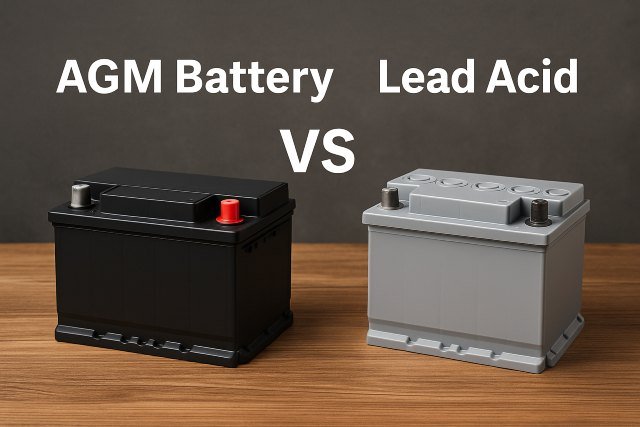
If you’re choosing a new battery for a car, boat, RV, solar system, or backup power bank, you’ll quickly run into the AGM battery vs lead acid debate. Both are technically lead-acid batteries, but they behave very differently in the real world when it comes to longevity, performance, maintenance, and cost.
AGM (Absorbent Glass Mat) batteries are sealed, maintenance-free, and designed for higher performance and deeper cycling, while traditional flooded lead-acid batteries are cheaper upfront but need more care and don’t last as long in demanding applications.
In this guide, we’ll compare AGM and conventional lead-acid batteries in depth so you can confidently choose the best option for your vehicle or power system.
AGM vs Flooded Lead-Acid: Quick Overview
| Feature | AGM Battery | Flooded Lead-Acid Battery |
|---|---|---|
| Design | Sealed, valve-regulated, electrolyte absorbed in glass mat | Vented, liquid electrolyte sloshing around plates |
| Maintenance | Maintenance-free (no topping up water) | Needs periodic watering and cleaning |
| Mounting | Flexible orientation, spill-proof | Must be kept upright to avoid spills |
| Vibration resistance | Excellent | Fair to good |
| Depth of discharge (typical) | Up to ~80% DoD (for deep-cycle AGM) | ~50% DoD recommended |
| Lifespan (typical) | ~4–8 years | ~3–6 years, often shorter under heavy cycling |
| Upfront cost | 1.5–3× higher | Lowest cost |
| Best for | High demand, deep cycling, off-grid, start-stop vehicles | Budget applications, backup use, low cycle counts |
agm battery vs lead acid: Key Differences Explained
1. Construction & Maintenance
AGM batteries are a type of sealed, valve-regulated lead-acid (VRLA) battery. Instead of free liquid acid, the electrolyte is absorbed into fiberglass mats between the plates. This makes them spill-proof, leak-resistant, and maintenance-free – you never have to add water.
Flooded lead-acid batteries (also called “wet cells”) use liquid electrolyte that can evaporate or spill. They must be kept upright and need regular maintenance: topping up distilled water, cleaning corrosion from terminals, and ensuring venting is adequate to release gases.
What this means for you:
- If you hate maintenance or your battery is hard to access, AGM is a big quality-of-life upgrade.
- For simple, accessible installations where you don’t mind checking water levels, a flooded battery can still be fine.
2. Safety, Venting, and Installation Flexibility
Because AGM batteries are sealed and use a recombinant gas design (most gasses recombine inside the battery), they:
- Are far less likely to spill acid
- Can be mounted on their side (within manufacturer limits)
- Produce minimal gas under normal charging conditions
That makes them safer for interior compartments, RVs, boats, and backup power systems in living spaces.
Flooded lead-acid batteries must:
- Be kept upright to prevent spills
- Be installed in ventilated compartments due to hydrogen gas release during charging
- Be protected from tipping, vibration, and impact
If your battery will live inside a cabin, RV, boat cabin, or tight compartment, AGM is usually the safer, cleaner choice.
3. Performance: Starting Power, Deep Cycling & Charge Acceptance
Cold cranking and high-load performance
AGM batteries typically deliver higher cold-cranking amps (CCA) and better voltage stability under heavy loads compared to standard flooded batteries of the same size. That’s why many modern start-stop and high-electrical-load vehicles now come with AGM from the factory.
Depth of discharge and cycling
For deep-cycle use (solar, trolling motors, RV house banks, etc.):
- AGM batteries can usually handle up to ~80% depth of discharge (DoD) when designed as deep-cycle AGM.
- Standard flooded deep-cycle lead-acid batteries are typically limited to ~50% DoD for good lifespan.
Deeper usable capacity per cycle means:
- You can get more runtime from the same rated amp-hours with AGM.
Charge acceptance / recharge speed
AGM batteries generally accept charge faster than flooded batteries, especially in the bulk and absorption phases, provided your charger is programmed correctly.
That’s valuable when:
- Running a generator in an RV or boat
- Charging from limited solar hours
- Doing short alternator-driven charge sessions
4. Longevity: Which Lasts Longer?
Lifespan is one of the most important parts of the AGM battery vs lead acid conversation – and the answer depends on how you use the battery.
According to multiple battery manufacturers and industry guides:
- AGM batteries often last 4–8 years in typical automotive or deep-cycle use.
- Flooded lead-acid batteries often last 3–5 years in automotive use, and 3–6 years as deep-cycle batteries if properly maintained.
AGM usually wins on longevity when:
- The battery is frequently cycled (discharged and recharged).
- Loads are high (winches, inverters, trolling motors, big stereo systems).
- Environments are harsh (vibration, heat, off-road, marine).
Flooded batteries can last reasonably long when:
- They are well maintained (watered, kept clean, properly charged).
- Deep discharges are rare (standby or backup applications).
5. Cost: Upfront Price vs Total Cost of Ownership
Here’s where flooded lead-acid shines: they’re cheaper at checkout.
Industry comparisons show:
- AGM batteries typically cost 40–100% more than standard flooded lead-acid of similar capacity, according to AAA and other battery suppliers.
- Some deep-cycle markets report AGM costing 2–3× more upfront than flooded versions.
Approximate Cost Comparison (per battery, mid-size group)
| Battery Type | Typical Price Range* | Relative Cost |
|---|---|---|
| Flooded lead-acid | $100–$200 | 1× |
| AGM lead-acid | $180–$400 | ~1.5–3× |
*Actual prices vary by brand, capacity, and region.
Total cost of ownership
However, because AGM:
- Lasts longer under cycling
- Tolerates deeper discharge
- Needs no maintenance
…it often catches up or wins over time in applications where the battery works hard (off-grid solar, RV, marine, commercial use).
If you only cycle the battery lightly or use it as occasional backup, the cheaper flooded battery can still be the better economic choice.
6. Vibration, Shock & Temperature Performance
AGM batteries are structurally tougher: the glass mat holds the plates firmly, so they resist vibration and shock far better than flooded batteries. That’s why they’re favored in:
- Off-road vehicles
- Boats and marine environments
- Powersports (motorcycles, ATVs, snowmobiles)
Temperature:
- AGM generally performs better in extreme cold and heat than flooded, with more reliable cranking and less performance drop in winter.
- Both types dislike chronic heat; high ambient temperature shortens the life of any lead-acid battery.
AGM Battery vs Lead Acid: Which Is Better for Your Use Case?
Cars & Start-Stop Vehicles
- Modern start-stop cars, premium vehicles, and high-load systems:
- AGM recommended. Many are factory-equipped with AGM due to repeated engine restarts, high accessory loads, and tighter charging control. Replacing AGM with a basic flooded battery often leads to shortened life and system issues.
- Older, basic vehicles with modest electrical demands:
- Flooded lead-acid may be perfectly adequate and more cost-effective.
RVs, Campervans & Off-Grid Setups
- Running fridges, lights, fans, inverters, and electronics off-grid?
- AGM wins: deeper usable capacity, better vibration resistance, faster recharge, no maintenance in hard-to-reach compartments.
- Occasional weekend use with hookups and shallow discharges?
- A flooded deep-cycle battery can be a good budget option if you’re willing to maintain it.
Boats & Marine Applications
- For trolling motors, electronics, and house banks exposed to vibration and moisture:
- AGM is often worth the extra cost for safety (sealed/spill-proof), durability, and low maintenance.
- For simple starter batteries in well-vented engine compartments:
- Flooded can still work, but AGM is increasingly preferred in modern builds.
Solar, UPS & Backup Power
- Daily-cycled solar banks / off-grid cabins:
- AGM or other advanced chemistries are usually recommended thanks to longer cycle life and deeper DoD tolerance.
- Occasional-use backup (e.g., UPS or emergency systems that rarely discharge):
- A well-maintained flooded bank may offer the lowest cost per year.
How to Choose: 6-Step Checklist
- Define your use case
- Starting only, deep cycle, or both?
- Daily use, weekend use, or rare backup?
- Check installation limits
- Is the battery inside a living space? Hard to reach? Subject to tilt or vibration?
- If yes, AGM strongly preferred.
- Calculate your usable capacity
- Flooded: plan on using only ~50% of rated Ah regularly.
- AGM deep-cycle: you may safely use up to ~70–80% depending on spec.
- Compare lifetime cost, not just sticker price
- Consider how many years (and cycles) you realistically need.
- AGM often wins where batteries are worked hard.
- Check your charger/alternator compatibility
- AGM needs the correct charging profile (voltage setpoints slightly different from flooded).
- Many modern smart chargers have AGM mode; if yours doesn’t, factor that in.
- Consider future upgrades
- If you might later add solar, inverters, or more electronics, starting with AGM is often a smarter long-term play.
FAQ: AGM Battery vs Lead Acid
1. Are AGM batteries still lead-acid?
Yes. AGM is a type of lead-acid battery that uses absorbent glass mats to hold the electrolyte. It’s also called VRLA or sealed lead-acid.
2. Can I replace a lead-acid battery with AGM in my car?
Usually yes, as long as the physical size, voltage, and capacity are appropriate and your charging system is compatible. Many modern vehicles already support AGM from the factory. When in doubt, check the owner’s manual or ask a trusted mechanic.
3. Do AGM batteries really last longer?
In demanding or deep-cycle applications, yes, they often do. AGM batteries generally provide better cycle life and tolerate deeper discharges compared to standard flooded batteries, provided they are charged correctly.
4. Are AGM batteries worth the higher cost?
They are usually worth it if:
- You cycle the battery regularly
- You need maintenance-free operation
- The battery is installed in a tough or enclosed environment
For occasional, gentle use on a tight budget, flooded lead-acid may still be the better value.
5. Can I use the same charger for AGM and flooded batteries?
Only if the charger supports both profiles. Smart chargers often have selectable modes for flooded, AGM, and sometimes gel. Over- or under-charging either type can significantly shorten its life, so always match the charger to the battery type.
Conclusion
When comparing AGM battery vs lead acid, there’s no single winner – it depends on how and where you’ll use the battery.
- Choose AGM if you want longer life under heavy cycling, better performance, faster recharge, maintenance-free operation, and safer installation in tight or indoor spaces.
- Choose flooded lead-acid if you need the lowest upfront cost, don’t mind doing maintenance, and your battery won’t be deeply discharged or heavily worked very often.
By weighing longevity, performance, and total cost (not just the purchase price), you can pick the battery type that’s truly right for your vehicle, boat, RV, or power system – and get the most value from every amp-hour.