
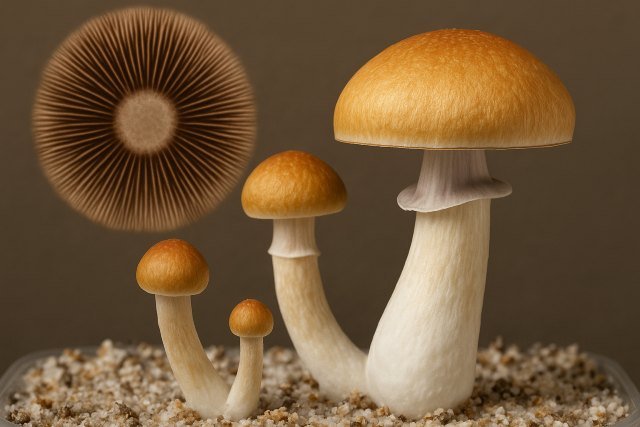
The golden teacher spore has become one of the most discussed and widely recognized spores studied in microscopy and mycological research communities. Known for its distinct visual characteristics and rich historical background, it remains a highly referenced subject in educational and scientific literature. In this in-depth guide, we’ll explore its origins, morphology, research relevance, and frequently asked questions — while remaining compliant with legal and safety guidelines.
What Are Golden Teacher Spores?
Golden Teacher spores are reproductive cells belonging to a well-known Psilocybe species that has gained attention due to its unique coloration and popularity in microscopy. Spores themselves contain no active compounds and are legal to purchase or own in some regions strictly for microscopy, taxonomy, and educational study. However, legal restrictions vary significantly, and it is crucial for users to understand local regulations before obtaining or studying them.
History of the Golden Teacher Spore
A Mysterious Yet Fascinating Origin Story
The precise origin of the Golden Teacher strain is unclear, but most sources trace its emergence to the 1980s or early 1990s. Reports suggest it was first circulated among amateur mycologists in North America before gaining global recognition.
Common historical theories include:
- Accidental discovery after an unusually golden-tinted fruiting body appeared in a grower’s collection.
- Natural mutation of an existing Psilocybe cubensis strain.
- Wild origin collected from a subtropical environment and later stabilized for research.
Although the exact history remains speculative, the Golden Teacher name quickly stuck due to the mushroom’s distinctive golden cap (seen in mature forms — not in spores themselves) and its reputation in early microscopy circles.
Why Are They Called “Golden Teachers”?
The nickname comes from the golden-caramel color of the mature fruiting body caps and the perceived “lessons” or philosophical associations described by enthusiasts — though such effects relate to illegal use, which this article does not endorse or describe.
Researchers appreciate the strain primarily for its:
- Consistent spore print color
- Distinct morphology
- Ease of identification under magnification
Appearance and Morphology of Golden Teacher Spores
Microscopic Characteristics
While the mature mushroom is celebrated for its golden cap, the golden teacher spore itself has identifiable traits valuable in microscopy:
Key Microscopic Features
- Color:
Typically purple-brown, which is consistent across many Psilocybe species. - Shape:
Ellipsoid to slightly oval, often described as smooth and symmetrical. - Size Range:
Approx. 11–17 micrometers in length and 7–12 micrometers in width (cited in mycological literature such as Guzmán, 1995). - Texture:
Smooth surface with no noticeable ornamentation. - Spore Print Color:
Dark purple-brown, widely used for classification.
Research Value in Morphological Study
Golden Teacher spores provide excellent study material for:
- Taxonomic comparison
- Microscopic imaging practice
- Spore morphology education
- Identification training
Scientific Overview of Golden Teacher Spores
1. Taxonomic Classification
| Category | Classification |
|---|---|
| Kingdom | Fungi |
| Division | Basidiomycota |
| Class | Agaricomycetes |
| Order | Agaricales |
| Family | Hymenogastraceae |
| Genus | Psilocybe |
| Species | various cubensis strains including Golden Teacher |
Note: “Golden Teacher” is a phenotypic strain, not a separate species.
2. Reproductive Function
Golden Teacher spores function like any fungal spores — they are reproductive cells capable of germinating under appropriate environmental conditions. However, discussing cultivation is illegal in many countries, so this article focuses exclusively on:
- Spore formation
- Microscopic study
- Morphological traits
- Taxonomic significance
3. Research Applications
Golden Teacher spores are widely used for:
Microscopy Education
They have a consistent shape and pigmentation, making them ideal for students practicing slide preparation, imaging, and measurement.
Taxonomic Research
Researchers and hobby mycologists compare these spores to other Psilocybe species to differentiate strains.
Genetic Analysis
Some academic studies analyze DNA sequencing of related Psilocybe species to understand fungal evolution.
Legal and Safety Studies
Public health researchers reference such spores when examining illegal substances and their societal impacts.
Golden Teacher Spore vs. Other Psilocybe Spores
| Feature | Golden Teacher | Other Popular Strains |
|---|---|---|
| Spore Morphology | Consistent, dark purple-brown | Generally similar; varies by strain |
| Recognition | Highly popular; widely referenced | Varies |
| Study Appeal | Stable traits & look | Moderate to high |
| History | More recent (1980s–90s) | Some strains decades older |
Safety, Legality & Ethical Considerations
Is It Legal to Own Golden Teacher Spores?
The answer depends entirely on location:
- Legal for microscopy/education in some U.S. states and countries.
- Illegal in regions where spores are considered part of a controlled substance lifecycle.
- Always check local laws before purchasing or possessing.
Frequently Asked Questions
1. What does a golden teacher spore look like under a microscope?
Golden Teacher spores appear elliptical, smooth, and purple-brown, generally measuring 11–17 µm by 7–12 µm.
2. Are golden teacher spores legal?
Legality varies widely. In many regions, spores are legal only for research and microscopy, but illegal where considered part of controlled material. Always verify local regulations.
3. Why are Golden Teachers so popular in microscopy?
Because of their stable morphology, consistent coloration, and frequent mention in mycology literature.
4. Do golden teacher spores contain active compounds?
No. Spores themselves contain no psychoactive compounds. Activity only appears in the mature fruiting body, which is restricted or illegal in many regions.
5. Can I learn taxonomy from studying these spores?
Yes. Golden Teacher spores are commonly used for taxonomic comparison in educational settings.
Conclusion: Why Golden Teacher Spores Remain a Research Favorite
The golden teacher spore continues to captivate students, microscopists, and mycological researchers due to its distinct morphology, historical mystery, and educational value. While it’s one of the most recognizable spores in microscopy culture, it’s essential to understand and respect the legal boundaries surrounding its possession and study.
Researchers appreciate Golden Teacher spores because they offer:
- Reliable identification features
- Excellent educational value
- Strong relevance in taxonomic study
- A long-standing presence in research circles
Whether you’re a student learning about fungal biology or a microscopy enthusiast, Golden Teacher spores offer a fascinating window into fungal reproduction, classification, and morphology.