
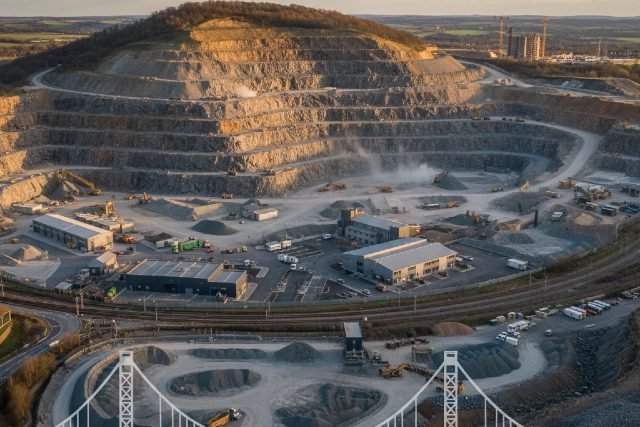
Bardon Hill Quarry is one of the most important contributors to construction and infrastructure development in the United Kingdom. Located in Leicestershire and operated by Aggregate Industries, the quarry has supplied high-quality granite aggregates for more than a century. These materials form the backbone of roads, railways, housing developments, and major civil engineering projects across the country.
In an era where infrastructure resilience, sustainability, and supply-chain reliability are critical, Bardon Hill Quarry supports construction and infrastructure by delivering consistent material quality, large production capacity, and efficient logistics. Its role extends beyond extraction, influencing economic growth, environmental responsibility, and long-term planning within the construction sector.
Understanding Bardon Hill Quarry and Its Strategic Importance
Bardon Hill Quarry is situated in a geologically rich area of Leicestershire, allowing access to durable granite that is ideal for demanding construction applications. Operated by Aggregate Industries, part of the global Holcim Group, the quarry benefits from modern processing facilities and strict quality controls. Its location near major transport corridors makes it especially valuable for supplying aggregates to the Midlands and wider UK.
Because aggregates are essential to almost every construction project, the strategic importance of a large quarry like Bardon Hill cannot be overstated. The Mineral Products Association reports that aggregates account for roughly eighty-five percent of all construction materials used in the UK. This means that without reliable sources such as Bardon Hill Quarry, national infrastructure development would face serious constraints.
Why Aggregates Are Fundamental to Construction and Infrastructure
Aggregates are the primary raw material used in concrete, asphalt, and foundation layers. They provide strength, stability, and durability to built structures. Roads, bridges, railways, airports, and buildings all rely on aggregates to perform safely over long periods.
Bardon Hill Quarry supports construction and infrastructure by supplying granite aggregates that meet British and European standards. Granite is particularly valued because of its resistance to wear, high compressive strength, and excellent performance under heavy traffic loads. These qualities make it suitable for both surface and structural applications in infrastructure projects.
Supporting Large-Scale Construction Projects Across the UK
One of the defining strengths of Bardon Hill Quarry is its ability to supply large volumes of aggregates consistently. Major infrastructure projects often span several years and require dependable material sources to avoid delays and cost overruns. Bardon Hill’s scale and operational capacity allow contractors and planners to rely on a steady supply throughout a project’s lifecycle.
The quarry has supported numerous large developments, including highway upgrades, rail improvements, and urban regeneration schemes. Its materials are commonly used in motorway construction, airport runways, and industrial developments where performance and longevity are critical.
The Role of Bardon Hill Quarry in Road Infrastructure
Road construction is one of the largest consumers of aggregates in the UK. Sub-base layers, asphalt mixes, and surface dressing all depend on high-quality stone. Bardon Hill Quarry plays a vital role in road infrastructure by supplying granite that offers excellent skid resistance and long-term durability.
Using durable aggregates reduces the frequency of road repairs and maintenance, which in turn lowers costs for local authorities and minimizes disruption for road users. Granite from Bardon Hill Quarry contributes to safer road surfaces and longer-lasting highways, particularly on heavily trafficked routes.
Rail Infrastructure and High-Quality Ballast Supply
Railways require specialist aggregates known as ballast, which supports the track structure and ensures effective drainage. Bardon Hill Quarry produces granite ballast that meets the stringent requirements of the rail industry. High-quality ballast helps maintain track alignment, reduces deformation, and extends the lifespan of rail infrastructure.
The Office of Rail and Road has highlighted the importance of high-grade ballast in improving railway performance and reducing maintenance needs. By supplying consistent, durable ballast, Bardon Hill Quarry supports construction and infrastructure within the UK rail network, benefiting both passenger and freight services.
Rail-Linked Logistics and Sustainable Transport
A key advantage of Bardon Hill Quarry is its direct connection to the rail network. Aggregates can be transported by train from the quarry to distribution hubs and construction sites across the country. This approach significantly reduces reliance on road haulage.
Rail transport lowers carbon emissions, reduces traffic congestion, and improves overall supply-chain efficiency. Network Rail estimates that rail freight can reduce carbon emissions by up to seventy-six percent compared to road transport. Through its rail-linked logistics, Bardon Hill Quarry aligns infrastructure support with national sustainability goals.
Contribution to Concrete and Asphalt Production
Concrete and asphalt are fundamental materials in modern construction. The performance of both depends heavily on aggregate quality. Granite from Bardon Hill Quarry is widely used in ready-mix concrete for housing, commercial buildings, bridges, and civil engineering structures.
In asphalt production, Bardon Hill aggregates help create durable road surfaces that resist deformation and wear. This improves road performance, reduces noise, and extends service life. As a result, Bardon Hill Quarry supports construction and infrastructure at every stage, from foundations to finished surfaces.
Sustainability and Environmental Responsibility
Modern quarrying places strong emphasis on environmental management, and Bardon Hill Quarry operates under strict regulatory controls. The quarry follows responsible extraction practices, progressive land restoration, and biodiversity enhancement initiatives. These measures ensure that worked areas are rehabilitated and returned to beneficial use over time.
Aggregate Industries has also invested in energy-efficient equipment and low-carbon processes at Bardon Hill. According to the Mineral Products Association, the UK aggregates sector has reduced carbon dioxide emissions by more than fifteen percent since 2010. Bardon Hill Quarry contributes to this progress through efficient operations and increased use of rail transport.
Economic Benefits for Local Communities and the National Economy
Beyond material supply, Bardon Hill Quarry provides significant economic benefits. It supports direct employment at the site, as well as indirect jobs through transport, maintenance, and construction supply chains. Training programmes and apprenticeships help develop skilled workers within the local area.
At a national level, a reliable aggregate supply underpins economic growth by enabling timely delivery of infrastructure projects. Roads, railways, and housing developments supported by Bardon Hill Quarry help improve productivity and quality of life across the UK.
Supporting Housing and Urban Development
Housing development depends heavily on aggregates for foundations, access roads, drainage systems, and concrete structures. With the UK facing ongoing demand for new homes, dependable aggregate sources are essential. Bardon Hill Quarry supports construction and infrastructure in the housing sector by ensuring that builders have access to consistent, high-quality materials.
This reliability helps developers meet project timelines and quality standards, which is especially important in large residential schemes and urban regeneration projects.
Bardon Hill Quarry Compared to Smaller Quarries
While smaller quarries play an important local role, Bardon Hill Quarry offers advantages that are critical for national infrastructure. Its high production capacity, rail transport capability, and long-term investment in sustainability make it suitable for large and complex projects. Smaller quarries often lack the scale and logistics needed to support major infrastructure programmes.
This distinction explains why Bardon Hill Quarry is frequently chosen for projects of regional and national significance.
Frequently Asked Questions
Bardon Hill Quarry primarily produces granite aggregates used in road construction, rail ballast, concrete, and asphalt. Its importance lies in supplying durable, high-quality materials essential for infrastructure projects across the UK. The quarry operates under strict environmental regulations and uses rail transport to reduce carbon emissions. It is operated by Aggregate Industries, part of the Holcim Group.
Conclusion: The Ongoing Importance of Bardon Hill Quarry
Bardon Hill Quarry remains a cornerstone of UK construction and infrastructure. By supplying high-performance granite aggregates, supporting sustainable transport through rail logistics, and investing in environmental responsibility, it plays a critical role in shaping the built environment.
As demand for resilient infrastructure and sustainable construction continues to grow, Bardon Hill Quarry supports construction and infrastructure by providing the materials, reliability, and expertise needed to build the UK’s future.