
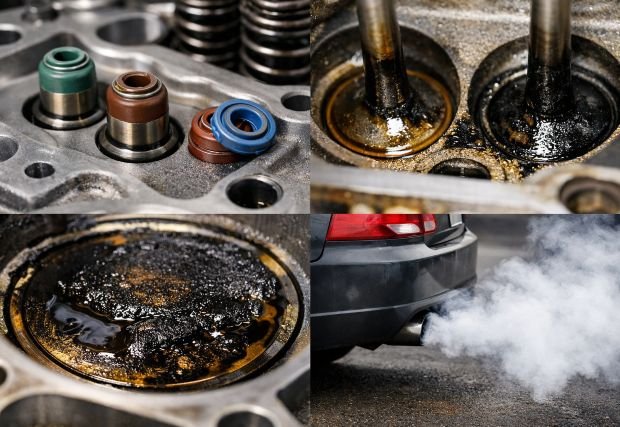
When a car starts using oil faster than it used to, or you notice blue-gray smoke at certain moments, valve seals are one of the most common (and most misunderstood) causes. Valve seals sit at the top of the engine’s valves and control how much oil is allowed to lubricate the valve stem and guide. They are not designed to be a perfect “no-oil-passes” barrier. Instead, they meter a very small amount of oil for lubrication while preventing excess oil from leaking into the combustion chamber and burning. That metering concept is central to how modern valve stem seals are engineered.
This article explains what valve seals do, why they fail, how failing valve seals create oil consumption and smoke patterns, how to diagnose them versus piston rings, and what a proper repair looks like in the real world.
What are valve seals and what do they do?
Valve seals are often called valve stem seals, because they seal around the valve stem where it passes through the cylinder head. Their job is to control the oil that lubricates the valve stem and valve guide area. The valve train needs oil, but too much oil in the wrong place gets pulled into the intake stream or pushed into the combustion chamber, where it burns and creates blue smoke.
What surprises many drivers is that a properly working valve seal still allows a controlled amount of oil to pass. Engineering and manufacturer literature describes valve stem seals in terms of “oil metering rate” and tuning the seal lip design and contact load so the seal delivers the lubrication the valve guide needs while minimizing consumption and deposits.
That’s why the same part can be both a protector and a culprit. When valve seals are healthy, they protect durability and emissions. When they harden or lose tension, they stop metering and start leaking.
How valve seals cause oil consumption and blue smoke
Oil consumption from valve seals happens because engine vacuum and gravity do a lot of work. When the engine is off, oil can seep slowly past worn seals and pool on the back of valves. When the engine is running, intake vacuum can pull oil down the guide area, especially during high-vacuum conditions such as deceleration or long idle.
Once oil enters the combustion chamber, it burns. Burning oil creates blue or blue-gray smoke and can also create deposits over time. Component suppliers describe this as a balancing act: the seal must provide enough oil for durability while avoiding excess oil that drives consumption and emissions concerns.
What does “normal” oil consumption look like?
There is no single universal number because manufacturers publish their own specifications and test procedures. Some service bulletins describe oil consumption testing and provide pass/fail thresholds. For example, one NHTSA-hosted bulletin states that if an oil consumption test shows the engine uses less than 0.946 liter (1 quart) in 3,200 km (2,000 miles), the engine meets the guideline in that procedure.
Volkswagen’s documentation has also referenced a consumption standard expressed as up to 0.5 quarts per 600 miles (0.5 liters per 1,000 km) in a specific measurement context.
The practical takeaway is simple. If you are adding oil noticeably more often than you used to, or smoke patterns appear, it’s worth diagnosing even if you’re not sure whether your engine is technically “within spec.” Specs don’t capture annoyance, odor, driveway embarrassment, or the long-term cost of deposits.
Valve seals symptoms that point strongly to leakage past the guides
Valve seal problems have a pattern. If you learn the pattern, you can often narrow down the cause before a single tool comes out.
Blue smoke on startup
This is the classic valve seal signature. The car sits overnight. Oil slowly seeps past worn seals. On the next cold start, that pooled oil burns off quickly, producing a puff of blue smoke. After a moment, it may largely disappear.
Smoke after long idle, then acceleration
Another common pattern is idling for a while at a stoplight or in traffic, then seeing a cloud of blue smoke when you pull away. High manifold vacuum at idle can pull oil past the seals, then the oil burns as engine speed rises.
Smoke on deceleration
Deceleration often produces high intake vacuum because the throttle is closed, which can increase oil pull-through past worn seals. If you see smoke when you lift off the throttle after a downhill coast, valve seals (and valve guides) become strong suspects.
Oil-fouled spark plugs, rough cold starts, or intermittent misfires
If one or two cylinders are getting more oil from specific seals or guide wear, spark plugs can foul unevenly. That can show up as rough cold starts, a stumble after startup, or intermittent misfire codes that come and go.
Valve seals vs piston rings: how to tell the difference
People often jump straight to “bad rings,” but oil burning has multiple entry points. The difference is usually the timing and conditions.
A helpful rule is this. Valve seal problems tend to show smoke on startup, after idling, or during deceleration, when vacuum and time allow oil to move down the valve area. Worn piston rings more often show smoke under acceleration and load, when cylinder pressure and blow-by are higher.
You will find this distinction repeated across diagnostic guides, with the strong recommendation that compression and leak-down testing can help separate ring sealing issues from valve seal and guide issues.
The diagnostic tests that actually move you from suspicion to proof
A careful shop will typically do a combination of observation and testing rather than replacing parts based on smoke alone.
A compression test is useful for a quick snapshot of cylinder sealing. A leak-down test is more informative because it helps you identify where air is escaping, which can suggest rings, intake valves, exhaust valves, or head sealing problems.
If compression and leak-down results look healthy and the smoke pattern screams startup or idle, the odds shift toward valve seals. If compression is low, leak-down is high, and you get smoke under throttle, rings and cylinder wear become more likely.
Another often-overlooked step is checking the PCV system. A faulty PCV setup can increase oil vapor ingestion and make a mild valve seal issue look worse than it is.
Why valve seals fail, and why some engines fail sooner
Valve seals live a hard life. They see heat cycles, oil splash, chemical exposure, and constant mechanical movement.
Heat and age harden the seal material
Over time, elastomers lose flexibility. The sealing lip can harden and lose its ability to maintain a controlled contact with the stem. Once that happens, the seal stops metering precisely and starts letting too much oil past.
Deposits and varnish change how oil moves
If oil change intervals were stretched or the engine ran hot, deposits can build around the valve guide area. Deposits can interfere with oil control, accelerate wear, and contribute to inconsistent sealing behavior.
Worn valve guides can overwhelm a new seal
This is a real-world scenario that causes frustration. A shop replaces valve seals, the car improves briefly, then smoke returns. If valve guide clearance is excessive, the valve stem can move enough that even a fresh seal can’t control oil effectively.
In higher-mileage engines, valve seals and guides can become a paired problem. Replacing seals alone may be a temporary improvement, but it’s not always a full solution.
Engine designs differ in how sensitive they are to wear
Some engines run hotter in the head area, some have different guide materials, and some use seal designs more sensitive to aging. Supplier literature highlights that seal lip design and contact load are deliberately tuned for specific engine conditions, which implies that changes in those parameters from wear or aging can quickly alter oil metering behavior.
Oil burning can damage emissions components over time
Even if the engine still drives fine, oil burning is not just a cosmetic issue. One long-term concern is emissions after-treatment performance.
A major reason is phosphorus from engine oil additives, including ZDDP chemistry. Technical research and government materials describe phosphorus as a catalyst poison, and studies investigate how oil-derived phosphorus deactivates oxidation catalysts under elevated oil consumption conditions.
This does not mean a single puff of smoke will ruin a catalyst. It does mean persistent oil burning can increase the risk of catalyst efficiency loss, higher emissions, and expensive downstream repairs.
Valve seal replacement: what the repair involves
Valve seals themselves are usually not the expensive part. Labor and access are.
Replacing valve seals without removing the cylinder head
On many engines, it’s possible to replace valve seals with the head still installed by using compressed air or a rope method to keep valves closed while the springs are removed and the seals are swapped. This approach can reduce total labor compared to removing the head, but it requires the right tools and experience.
This method makes the most sense when compression is good, guides are likely acceptable, and the engine’s main issue is startup or idle smoke.
Removing the head and rebuilding the valve train
If there is evidence of guide wear, poor sealing, or multiple top-end issues, pulling the head may be the better long-term repair. It allows measurement of guide clearance, inspection of valve faces and seats, and machining if needed.
This is also the route often chosen when the engine already needs related work, such as a head gasket job or timing component service that requires major teardown.
Practical tips to reduce oil burning while you diagnose the cause
If you’re still diagnosing or scheduling a repair, there are steps that help you manage the situation and prevent misdiagnosis.
Start by tracking oil consumption accurately. Several service bulletins outline structured oil consumption tests and emphasize verifying no external leaks and monitoring over a defined mileage window before concluding the engine is abnormal.
Keep the oil at the proper level. Running low increases wear risk and can turn a manageable issue into engine damage.
Make sure you are using the correct oil specification and viscosity for the engine. Incorrect viscosity can worsen consumption or change smoke behavior, which confuses diagnosis.
Verify the PCV system. A stuck or restricted PCV can increase oil ingestion and mimic valve seal symptoms.
Frequently asked questions about valve seals
Can valve seals cause oil consumption without constant smoke?
Yes. Small amounts of oil can burn without producing a dramatic visible plume, especially with modern exhaust systems. Many drivers only notice the issue when consumption becomes frequent or when smoke appears in certain conditions like cold start.
What is the most common sign of failing valve seals?
A brief puff of blue smoke on startup after the vehicle has been sitting is one of the most common signs, especially when the engine otherwise runs well.
Can valve seals cause smoke on acceleration?
They can, but it is more commonly linked to smoke after idling or during deceleration. Severe valve seal wear can show up in more situations, and some guides note that bad seals can produce smoke after an idle period and then acceleration.
Is valve seal replacement worth it?
Often, yes, if the engine is otherwise healthy and the problem is mostly startup or idle smoke and rising oil use. If tests indicate ring wear or significant blow-by, the better spend may be a broader repair plan rather than seals alone.
Can oil burning from valve seals harm the catalytic converter?
Persistent oil burning increases the risk of catalyst performance loss over time, in part because phosphorus compounds derived from oil additives are documented catalyst poisons and have been studied for their deactivation effects under elevated oil consumption.
Conclusion
Valve seals are small parts with an outsized impact. When valve seals are healthy, they meter oil to protect the valve stem and guide while limiting oil consumption and deposits. When they age, harden, or lose control, oil can leak into the combustion chamber and show up as blue smoke on startup, smoke after idle, and steadily rising oil consumption. Supplier and engineering literature emphasizes that valve stem seals are tuned by design to control oil metering rate for durability, emissions, and consumption balance, which is why wear can change behavior noticeably.
If your smoke pattern matches valve-seal behavior, the smartest path is consistent oil tracking, PCV verification, and compression plus leak-down testing to separate seals from rings. Once confirmed, repairing valve seals can be one of the most cost-effective ways to reduce oil burning, stabilize consumption, and protect emissions components.