
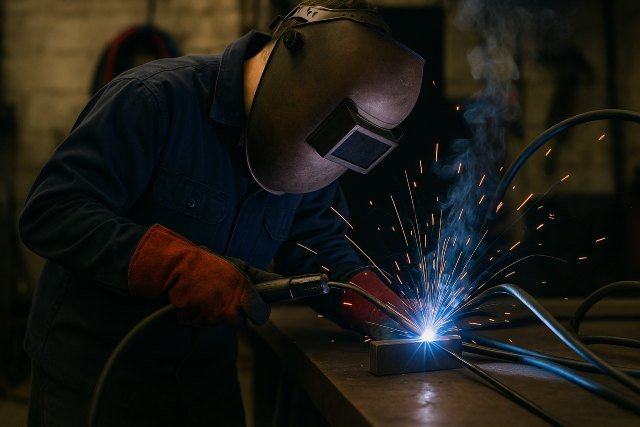
If you’re running stick, MIG, or TIG away from your power source, your welding leads can make or break your setup. Undersized or overly long leads cause voltage drop, poor arc performance, overheating, and even fire hazards. Sized and maintained correctly, they deliver full power to the arc, stay cool, and last for years.
In this guide, we’ll cover how to choose the correct gauge, how long your welding leads can be, basic amp/length charts, and essential safety practices so you can weld efficiently and safely.
What Are Welding Leads?
Welding leads are the insulated copper cables that connect your welding machine to:
- The electrode holder (stinger / gun lead)
- The work clamp (ground / return lead)
They carry high welding currents (often 100–400 amps or more) from the power source to the weld. Because of this, they must be:
- Properly sized (gauge) for the current
- Sized for the total length of the circuit (electrode + work lead)
- Rated for flexibility and duty cycle
- Maintained in good condition to avoid hazards
Why Welding Lead Size and Length Matter
Choosing the right welding lead size and length affects:
1. Arc Performance
Too-small or too-long leads cause voltage drop and a weaker arc. You might notice:
- Difficulty maintaining arc
- Poor penetration
- Spatter and unstable puddle
2. Cable Temperature
Undersized cables run hot. This accelerates insulation breakdown and can cause:
- Burned insulation
- Exposed copper
- Fire risk on combustible surfaces
3. Efficiency and Productivity
Correctly sized leads maintain voltage where it matters: at the arc. This means:
- Better weld quality
- Less rework
- More comfortable handling (cooler, more flexible leads)
Key Factors When Choosing Welding Leads
When selecting welding leads, always consider:
- Maximum welding current (amps)
- Total lead length (electrode + work lead)
- Duty cycle of the machine
- Welding process (SMAW, GMAW, FCAW, GTAW)
- Environment (shop, field, high heat, oil, abrasion)
Understanding Welding Lead Sizes (AWG & “Gauge”)
Welding cable is typically sized by:
- AWG (American Wire Gauge) for smaller sizes
- kcmil (MCM) or trade sizes for larger cable
Common welding cable sizes:
- 6 AWG
- 4 AWG
- 2 AWG
- 1 AWG
- 1/0 AWG (pronounced “one-aught”)
- 2/0 AWG
- 3/0 AWG
- 4/0 AWG
Rule of thumb:
The higher the current and the longer the lead, the larger the cable (lower AWG number / bigger “aught”).
Welding Lead Sizing: Simple Reference Table
Below is a generalized guide many welders use for copper welding cable, assuming typical duty cycles and total circuit length (electrode + work return). Always consult the machine manual and local codes as your final authority.
Recommended Welding Lead Size by Amps & Total Length
| Max Amps | Total Circuit Length (ft) | Recommended Size |
|---|---|---|
| 100–150 A | Up to 50 ft | 6 AWG |
| 100–200 A | 50–100 ft | 4 AWG |
| 150–250 A | 50–100 ft | 2 AWG |
| 200–300 A | 50–150 ft | 1/0 AWG |
| 250–350 A | 100–200 ft | 2/0 AWG |
| 300–400 A | 150–250 ft | 3/0–4/0 AWG |
Total length means:
Electrode lead + work lead + any extension cables.
So if you have a 75 ft stinger and a 75 ft ground, your total circuit length is 150 ft.
Step-by-Step: How to Size Your Welding Leads
Here’s a straightforward way to choose the right welding leads for your setup.
Step 1: Find Your Maximum Welding Current
Check your machine’s:
- Nameplate
- User manual
Identify:
- Maximum output amps
- Typical amps you use (e.g., 125–200 A for most stick work)
Step 2: Measure or Plan Total Circuit Length
Add together:
- Electrode lead length
- Work/ground lead length
- Any additional extensions or whips
Example:
- 50 ft stinger + 50 ft ground = 100 ft circuit
Step 3: Use a Sizing Table or Chart
Using the table above:
- At 200 A and 100 ft, 4 AWG or 2 AWG is commonly used.
- If you weld at higher amps or longer length, move up to 1/0 or 2/0.
Step 4: Consider Duty Cycle
If you weld heavily and continuously (high duty cycle):
- Size one step larger (e.g., from 2 AWG to 1/0)
- This keeps leads cooler and reduces voltage drop
For light, intermittent use, the “base” recommendation might be sufficient.
Proper Welding Lead Length: How Long Is Too Long?
You want enough length to work comfortably and safely without dragging the machine constantly, but not so much that voltage drop becomes a problem.
General Guidelines
- For hobby/garage welders: 25–50 ft per lead is usually enough
- For field work: 50–100 ft, sometimes more
- For very long runs, consider remote power sources or larger cable
If your weld starts to feel “weak” at longer distances, it’s often a sign your leads are too small for that length and current.
Welding Leads for Different Processes
1. Stick Welding (SMAW)
- Often uses longer leads for field work
- Higher amperage (100–300 A commonly)
- Needs flexible, high-duty welding cable
2. MIG / Flux-Cored (GMAW/FCAW)
- The “lead” is often the gun cable, plus the work clamp lead
- Still important to size the work lead correctly
3. TIG Welding (GTAW)
- Typically lower amps (50–200 A)
- Very sensitive to ripple and voltage drop
- Proper grounding and good cable connections help arc stability
Choosing the Right Insulation and Flexibility
Not all welding leads are the same, even if they share the same gauge.
Look for:
- Fine-strand copper → more flexible, easier to coil and route
- EPDM or neoprene jacket → oil, heat, and abrasion resistant
- Welding cable rated (not generic extension cord wire)
Avoid:
- Household extension cords (not rated for welding current)
- Stiff, low-flex copper that kinks and cracks the insulation
Safety Tips for Using Welding Leads
Because welding leads carry high current, safety is crucial.
1. Inspect Cables Regularly
Look for:
- Cracked or melted insulation
- Exposed copper
- Stiff, brittle sections
- Loose or corroded lugs
Replace damaged cables immediately. Do not tape over severe damage as a permanent fix.
2. Check All Connections
Loose connections create:
- Heat
- Arcing
- Voltage drop
Make sure:
- Lugs are tight and clean
- Connectors are secure
- Ground clamp bites on clean metal, not rust or paint
3. Avoid Coiling Cables Tightly While Welding
Tightly coiled leads can:
- Overheat
- Induce unwanted magnetic fields
- Create trip hazards
Uncoil them so air can flow around the cable.
4. Keep Welding Leads Away from:
- Water and wet surfaces
- Hot slag and spatter
- Sharp edges
- Traffic (forklifts, vehicles)
Use hooks, stands, or cable covers where needed.
5. Never Exceed the Cable Rating
Don’t “cheat” by running:
- 300+ amps through thin 6 or 4 AWG leads for long periods
This will overheat cables and can start fires.
6. Disconnect Leads Properly
Before servicing:
- Turn off the machine
- Disconnect from power
- Let cables cool if they’re hot
Never pull on the cable itself to disconnect — always grab the connector or lug.
Extending Welding Leads: When You Need More Reach
Sometimes you need more length than your standard leads.
Safe Practices for Extensions
- Use same size or larger cable than your main lead
- Ensure tight, clean connectors
- Keep total length and voltage drop in mind
If you are frequently coupling multiple extensions, it might be more cost-effective (and safer) to buy a single longer cable sized for the job.
Ground (Work Lead) Matters as Much as the Stinger
Many people focus on the stinger lead and forget the work lead:
- It carries the same current as the electrode lead
- It must be the same or larger gauge
- A weak or loose ground will cause hard starts, arc blow, and excessive heat
Make sure the work clamp:
- Is sized correctly
- Makes solid contact
- Isn’t connected to thin or rusty material far from the weld
Example Setups for Welding Leads
Example 1: Garage Weldor
- Machine: 180 A inverter stick welder
- Use: Light fabrication & repairs
- Leads: 25–50 ft total, around 6–4 AWG
Example 2: Farm / Ranch Work
- Machine: 250 A engine drive
- Use: Structural repairs, fencing, equipment
- Leads: 50 ft stinger + 50 ft work = 100 ft
- Recommended: 2 AWG or 1/0 AWG
Example 3: Structural Steel Field Work
- Machine: 300–400 A engine drive
- Use: All-day production welding
- Leads: 100 ft stinger + 100 ft work = 200 ft
- Recommended: 2/0–4/0 AWG, high-quality flexible cable
Storing and Caring for Welding Leads
Proper storage extends the life of your welding leads.
Best Practices
- Coil loosely (big loops, not tight wraps)
- Hang on hooks or reels
- Keep dry and off the floor
- Avoid piling heavy objects on cables
- Occasionally wipe down with a clean rag
Good care prevents jacket cracking and internal strand damage.
FAQs About Welding Leads
1. What size welding leads do I need for 200 amps?
For around 200 amps, typical recommendations:
- Up to ~50 ft total: 4 AWG
- Up to ~100 ft total: 2 AWG
If you weld continuously at that output, consider 1/0 AWG.
2. Can welding leads be too long?
Yes. Extremely long welding leads with small gauge create excessive voltage drop and heat. For very long runs, upsize the cable (e.g., from 2 AWG to 1/0 or 2/0).
3. Can I repair damaged welding leads?
Minor jacket nicks can sometimes be temporarily covered, but:
- Exposed copper
- Severe jacket damage
- Burned spots
…generally mean that section should be replaced or the entire cable swapped out.
4. Are welding leads and jumper cables the same?
No. Good welding cable:
- Uses finer strands
- Is more flexible
- Is rated for continuous high current
Jumper cables are not designed for continuous-duty welding current.
5. Do I need different leads for AC vs. DC welding?
The same welding leads can be used for AC or DC as long as they are properly sized. The key factors are amps, length, and duty cycle, not polarity.
Conclusion
Correctly sized and maintained welding leads are critical for safe, efficient welding. By matching cable gauge to your welding current and total lead length, using high-quality flexible welding cable, and following basic safety and maintenance practices, you can dramatically improve arc performance, reduce downtime, and extend the life of both your leads and your welder.
Before your next project, take a few minutes to check your lead size, total circuit length, and cable condition. A small investment in the right welding leads today can save you from poor welds, equipment damage, and safety hazards tomorrow.